
PM Fasal Bima Yojana (Pradhan Mantri Fasal Bima Yojana, PMFBY) is India’s flagship crop insurance scheme. It protects farmers against crop loss caused by drought, floods, pests, unseasonal rain and other natural risks, at a very low premium. With the Rabi 2026-27 season underway, this guide explains premium rates, eligibility, covered risks, documents, how to apply online and how to claim compensation.
Whether you grow paddy, wheat, pulses, banana or vegetables, understanding PM Fasal Bima Yojana can save your family from heavy losses in a bad season.
PM Fasal Bima Yojana 2026: Key Highlights
| Feature | Details |
|---|---|
| Launched | 2016 |
| Ministry | Ministry of Agriculture and Farmers Welfare |
| Farmer premium – Kharif | 2% of sum insured |
| Farmer premium – Rabi | 1.5% of sum insured |
| Commercial / horticulture crops | 5% of sum insured |
| Balance premium | Shared by Centre and State |
| Enrolment | Voluntary for all farmers |
| Portal | pmfby.gov.in |
| Helpline | 14447 (Krishi Rakshak Portal and Helpline) |
What Is PM Fasal Bima Yojana?
PM Fasal Bima Yojana is a government-supported crop insurance scheme that pays compensation when notified crops are damaged by natural calamities, pests or diseases. The farmer pays only a small share of the premium, while the rest is paid by the Central and State governments. Claims are calculated based on crop-cutting experiments, technology-based yield estimates and individual assessment in specific cases.
The scheme is implemented through empanelled public and private insurance companies, which are allotted to districts or clusters by state governments. Banks, cooperative societies, Common Service Centres (CSCs) and the online portal all accept enrolments.
Premium Rates Under PM Fasal Bima Yojana
The biggest advantage of PM Fasal Bima Yojana is the low farmer premium:
- Kharif food and oilseed crops: 2% of the sum insured
- Rabi food and oilseed crops: 1.5% of the sum insured
- Annual commercial and horticultural crops: 5% of the sum insured
Premium Example
Suppose the sum insured for wheat in your district is ₹60,000 per hectare. For Rabi, your share at 1.5% is ₹900 per hectare. The actual premium charged by the insurer may be much higher, but the difference is paid by the governments. The sum insured per hectare is fixed by the District Level Technical Committee, so it varies by district and crop.
Who Is Eligible?
- All farmers, including sharecroppers and tenant farmers, growing notified crops in notified areas.
- Loanee farmers (with crop loans/KCC) and non-loanee farmers can both join.
- Since Kharif 2020, enrolment is voluntary even for loanee farmers. Loanee farmers who do not want coverage must give an opt-out declaration to their bank before the deadline.
- Tenant and sharecropper farmers need documents showing their right to cultivate as required by the state.
If you have a Kisan Credit Card, your bank may enrol you automatically unless you opt out. Learn more in our guide on Kisan Credit Card interest rate.
Risks Covered Under PM Fasal Bima Yojana
| Stage | What is covered |
|---|---|
| Prevented sowing | When most farmers in an area cannot sow due to deficit rain or adverse weather |
| Standing crop | Yield loss due to drought, dry spell, flood, inundation, pests, diseases, landslides, natural fire, lightning, storm, hailstorm, cyclone |
| Post-harvest losses | Damage to crops kept in cut-and-spread condition in the field for up to 14 days, due to cyclone, cyclonic rain, unseasonal rain or hailstorm |
| Localised calamities | Hailstorm, landslide, inundation, cloudburst and natural fire affecting individual farms |
The government has announced that wild animal attacks and paddy inundation are being included as localised risks from recent seasons, subject to state notification. Check with your agriculture office whether this is notified in your district.
What Is Not Covered
- Losses due to war, nuclear risks, riots or malicious damage
- Theft or acts of enmity
- Damage by domestic or wild animals unless specifically notified
- Other preventable risks
Documents Required for PM Fasal Bima Yojana
- Aadhaar card (mandatory)
- Bank account passbook or cancelled cheque (Aadhaar-seeded account preferred)
- Land records: RoR / land possession certificate / tax receipt (in Kerala, the land tax receipt or possession certificate)
- Sowing certificate or self-declaration of the crop sown, as required by the state
- For tenants and sharecroppers: tenancy agreement or certificate as notified by the state
- Mobile number for SMS updates
How to Apply for PM Fasal Bima Yojana Online
- Visit the official portal pmfby.gov.in.
- Click on “Farmer Corner” and choose “Apply for Crop Insurance Yourself”.
- Register as a guest farmer with your mobile number and verify the OTP.
- Fill in your personal details, address, bank account and Aadhaar.
- Select the season (Rabi), year, state, district and the crop you have sown.
- Enter land details such as survey number and area.
- Upload land records, sowing certificate and bank passbook.
- Check the premium amount shown and pay online.
- Download and save the application receipt or policy acknowledgement.

Other Ways to Apply
- Through your bank: Loanee farmers are covered through the bank that gave the crop loan unless they opt out.
- Common Service Centre (CSC): Visit a CSC or Akshaya centre and ask the operator to enrol you on the portal.
- Insurance company office or agent: Authorised intermediaries can also enrol farmers.
- Crop Insurance mobile app: The official app supports enrolment, status check and loss intimation.
PM Fasal Bima Yojana Last Date for Rabi 2026-27
The enrolment cut-off for Rabi crops is fixed by each state in its notification and usually falls in December, though some crops and states have earlier or later dates. Since dates vary by crop and district, check the PMFBY portal, your bank, CSC or the local agriculture office as early as possible. Enrol well before the deadline, because servers and CSCs become very busy in the last few days.
How to Claim Crop Insurance Under PM Fasal Bima Yojana
For Area-Wide Losses
For widespread losses such as drought or a poor harvest across a village or block, you do not need to file an individual claim. Yield is assessed through crop-cutting experiments and technology. If the actual yield is below the threshold yield, the claim is calculated and paid to all insured farmers in that area directly into their bank accounts.
For Localised Calamities and Post-Harvest Losses
For individual losses due to hailstorm, landslide, inundation, cloudburst, natural fire or post-harvest damage from unseasonal rain or cyclone, you must inform within 72 hours. You can intimate the loss through:
- The Crop Insurance app
- The Krishi Rakshak helpline 14447
- The insurance company’s toll-free number
- Your bank branch or the agriculture department office
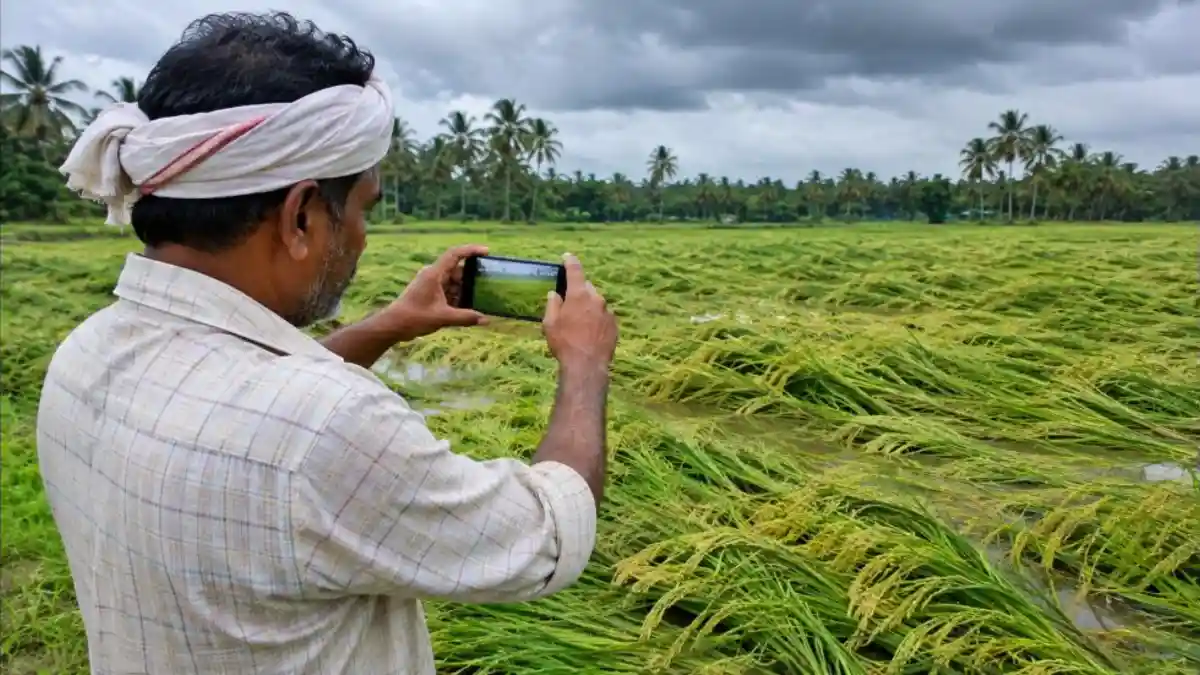
Give details of the survey number, crop, date and cause of loss. The insurer appoints a loss assessor to visit the field. Keep photos of the damaged crop with date and location as supporting evidence.
How to Check PMFBY Application and Claim Status
- Go to pmfby.gov.in and open “Application Status”.
- Enter your receipt number and captcha.
- View the policy status and, after the season, the claim status.
The Crop Insurance app also shows policy and claim details using your mobile number. If a claim is delayed, raise a grievance through the app, helpline or district grievance committee.
How the Claim Amount Is Calculated
For area-wide yield losses, PM Fasal Bima Yojana uses a simple formula. The insurer compares the actual yield in your insurance unit (usually a village or gram panchayat for major crops) with the threshold yield.
Claim = (Threshold Yield − Actual Yield) ÷ Threshold Yield × Sum Insured
The threshold yield is usually the average yield of the best years in the recent past multiplied by the indemnity level (for example 70%, 80% or 90%) fixed for that crop and area.
Worked Example
Assume the threshold yield of paddy in your village is 40 quintals per hectare and the sum insured is ₹80,000 per hectare. Because of heavy rain, the actual yield measured through crop-cutting experiments is only 30 quintals.
- Shortfall = 40 − 30 = 10 quintals
- Loss percentage = 10 ÷ 40 = 25%
- Claim = 25% × ₹80,000 = ₹20,000 per hectare
This PM Fasal Bima Yojana example is only an illustration. Actual figures depend on the notification for your district.
Rabi Crops Commonly Covered
Each state notifies its own list, but Rabi crops commonly covered include wheat, barley, gram (chana), lentil (masoor), mustard and rapeseed, Rabi paddy in southern and eastern states, Rabi maize, and several vegetables and horticultural crops. Kerala’s notified crops in the Rabi and summer seasons can include paddy (Mundakan and Puncha seasons), banana, vegetables and other horticulture crops, depending on the district.

If your crop is not on the notified list for your area, you cannot insure it under PM Fasal Bima Yojana that season. In that case, ask your Krishi Bhavan about state schemes or weather-based insurance that may cover it. Planning your crop choice with insurance coverage in mind is a smart way to reduce risk, especially if you depend on a single crop for most of your yearly income.
Kharif vs Rabi: Quick Comparison
| Point | Kharif | Rabi |
|---|---|---|
| Main crops | Paddy, maize, cotton, soybean, groundnut | Wheat, mustard, gram, barley, Rabi paddy in some states |
| Farmer premium (food/oilseed) | 2% | 1.5% |
| Typical enrolment cut-off | July–August | December (varies by state) |
| Commercial/horticulture premium | 5% | 5% |
Understanding Sum Insured
Under PM Fasal Bima Yojana, the sum insured per hectare is generally equal to the scale of finance for that crop, fixed by the District Level Technical Committee. Scale of finance is the amount banks consider necessary to grow one hectare of a crop, including seeds, fertiliser, labour and other costs. Because of this, the sum insured differs from district to district and crop to crop.
Your total sum insured is the per-hectare figure multiplied by the area you insure. If you grow two notified crops on different plots, each crop is insured separately with its own premium and sum insured. Always check that the area you enter matches your land records and the area actually sown.
Grievance Redressal
If you are unhappy with the processing of your PM Fasal Bima Yojana policy or claim, there is a structured complaint system:
- First, contact the insurance company through the helpline or Crop Insurance app.
- Call the Krishi Rakshak helpline 14447 to register a complaint with a docket number.
- If unresolved, approach the District Level Grievance Redressal Committee through your agriculture office.
- Further escalation is possible to the State Level Grievance Redressal Committee.
Keep your policy receipt, land documents, loss intimation number and photos ready when you file a complaint.
Tips Before You Enrol in PM Fasal Bima Yojana
- Visit your Krishi Bhavan or agriculture office to confirm which crops are notified in your village this season.
- Check the premium and sum insured on the portal before paying.
- Make sure your Aadhaar name exactly matches your bank account and land records.
- Insure the actual sown crop; if you change the crop, inform your bank or insurer before the cut-off date.
- Save the insurer’s toll-free number and download the Crop Insurance app before the season begins.
- Encourage neighbouring farmers to join too. Area-based assessment works best when more farmers in a village are insured.
Following these tips will help you get the full benefit of PM Fasal Bima Yojana when you need it most.
Who Pays What: A Simple Illustration
Under PM Fasal Bima Yojana the actuarial premium is decided through bidding by insurance companies. Suppose the actuarial premium for a Rabi crop is 8% of the sum insured. The farmer pays only 1.5%, and the remaining 6.5% is shared between the Central and State governments (in most states equally; in north-eastern and Himalayan states the Centre bears a larger share). This sharing is what makes PM Fasal Bima Yojana affordable for small and marginal farmers.
Use of Technology in PMFBY
To make claims faster and fairer, PM Fasal Bima Yojana now uses technology at many stages:
- YES-TECH: Yield estimation using remote sensing and technology, combined with crop-cutting experiments.
- WINDS: A weather information network using automatic weather stations and rain gauges.
- Digital claims: Claim payments are sent directly to bank accounts through the national portal.
- Smartphone crop-cutting: Field data collected with geo-tagged photos to reduce disputes.
These steps aim to cut delays that farmers often faced in earlier years.
PM Fasal Bima Yojana in Kerala
In Kerala, crop insurance for farmers is offered through PMFBY, the Restructured Weather Based Crop Insurance Scheme (RWBCIS) for certain crops, and the State Crop Insurance Scheme. Notified crops and insurance companies are announced by the Agriculture Development and Farmers’ Welfare Department each season. Farmers can enrol through banks, Akshaya centres (CSCs), Krishi Bhavans and the national portal.
Kerala farmers growing paddy, banana, vegetables, coconut, pepper and other crops should visit their Krishi Bhavan to know which scheme covers their crop this season. The state’s AIMS portal is used for several agriculture schemes and subsidies, and Krishi Bhavan officers can guide you on combining state and central coverage where allowed.
Common Mistakes Farmers Make
- Missing the deadline: Enrolment after the cut-off is not accepted.
- Wrong crop or area: Insuring a crop different from what is actually sown can lead to claim rejection.
- Bank details mismatch: Name or account number errors delay claim payments.
- Not reporting local loss in 72 hours: Late intimation may make the claim invalid.
- Not keeping the receipt: Always save your application receipt and policy details.
Benefits of PM Fasal Bima Yojana at a Glance
- Very low farmer premium with large government support
- Coverage from sowing to post-harvest stage
- Protection for both loanee and non-loanee farmers
- Direct bank transfer of claims
- Helps farmers keep their credit eligibility after a bad season
Farmers who receive PM-Kisan support should also keep their eKYC and land seeding updated. Read our guide on PM Kisan beneficiary status to check yours.
Frequently Asked Questions
What is the premium for Rabi crops under PM Fasal Bima Yojana?
Farmers pay 1.5% of the sum insured for Rabi food and oilseed crops, and 5% for commercial and horticultural crops.
Is PMFBY compulsory for loanee farmers?
No. Since Kharif 2020 it is voluntary. Loanee farmers who do not wish to join must submit an opt-out form to their bank before the deadline.
How soon should I report crop loss?
Report localised and post-harvest losses within 72 hours through the Crop Insurance app, helpline 14447 or your insurer.
Can tenant farmers apply?
Yes, tenant farmers and sharecroppers can join with documents prescribed by their state government.
Where is the claim amount paid?
Claims are paid directly into the farmer’s bank account linked in the application.
Conclusion
PM Fasal Bima Yojana gives farmers strong protection against weather and pest risks at a small premium. For the Rabi 2026-27 season, check your state’s notified crops and cut-off dates, keep your Aadhaar, bank and land documents ready, and enrol early through the portal, bank or CSC. Report any local loss within 72 hours so your claim is processed smoothly.
Crop insurance is not an expense but a safety net. One bad season without cover can push a family into debt for years, while a small premium paid on time keeps your farm finances stable. Talk to your bank manager, Krishi Bhavan officer or nearest Akshaya centre this week, confirm the notified crops for your village and finish your enrolment before the rush. Keep all receipts safely, and share this information with fellow farmers in your area.
Disclaimer: Premium rates, notified crops and deadlines are decided by the Centre and states. Please verify on pmfby.gov.in or with your local agriculture office.